What You'll Actually Send
Four design styles, all themed for podiatry practices and ready to customize. Recall front, booking offer back, just pick the look that matches your practice.
Bold

Photo
Minimal

Gradient

Quarterly diabetic foot exam reminders, custom orthotics fitting recalls, and lapsed-patient reactivation cards. Pre-built playbooks for podiatry practices.
Start Free Mail a free sample to yourselfDiabetic patients need a foot exam every 90 days: American Diabetes Association guidance. Most miss the cadence by months, leading to higher rates of ulcers, infections, and lost continuity-of-care revenue. A clinical-tone card 30 days before the next exam, paired with a front-desk call, keeps high-risk patients on schedule and protects against preventable complications.
Diabetic Foot Care: Quarterly Recall Playbook: 3 waves over 45 days
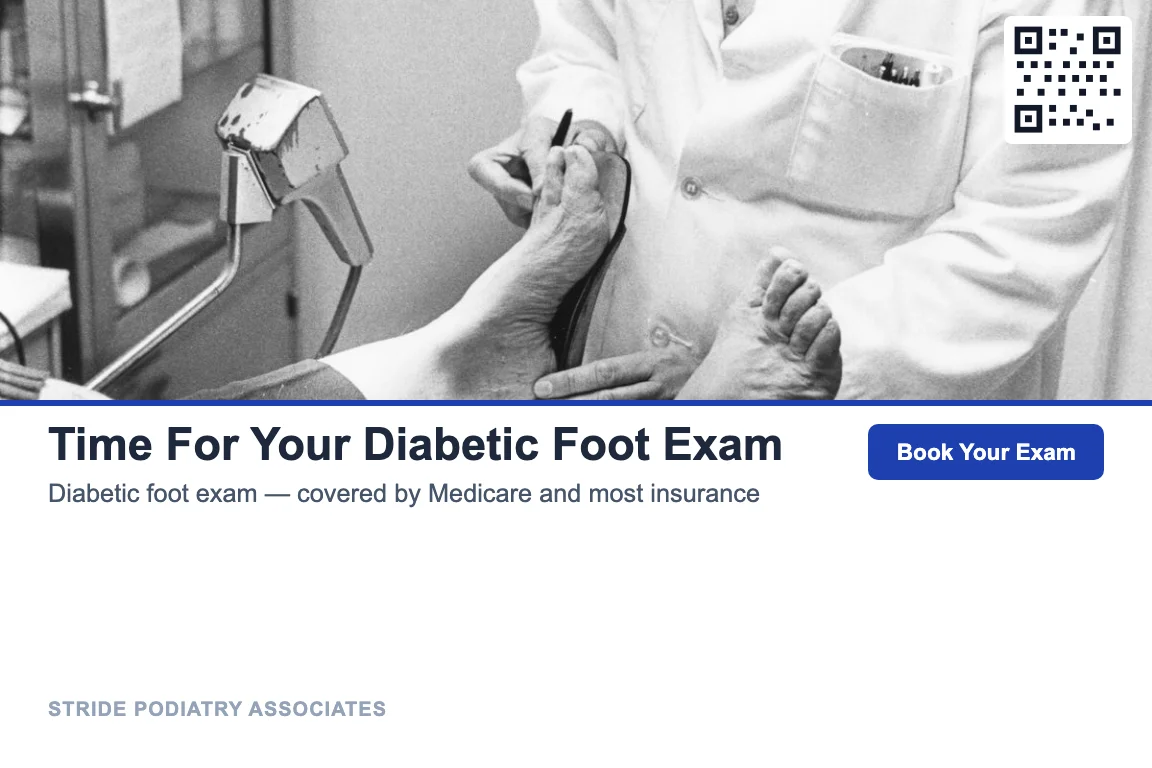
"Your next diabetic foot exam is due in 30 days." Clinical tone, photo of the podiatrist, QR straight to the booking page. Frames the visit as ongoing care, not a marketing push.
Front desk calls anyone who scanned the QR but didn't book. Pre-loaded script: "Saw you scanned our reminder. Let's get your quarterly foot check on the calendar. Tuesday morning OK?"
"Your foot exam is due this week." Concrete urgency for the 10–15% of patients who saw the first card but kept postponing. Patients past Wave 3 move to a higher-touch outreach list.
Four design styles, all themed for podiatry practices and ready to customize. Recall front, booking offer back, just pick the look that matches your practice.
Bold
Photo
Minimal
Gradient
Wave timing, clinical-tone copy, and front-desk call scripts come pre-configured. You only customize the practice photo, podiatrist name, and branding.
Pull from TRAKnet, eClinicalWorks, NextGen, Epic, or Athena. Filter for patients with diabetic diagnosis codes and last visit 60–90 days ago. Upload the CSV.
Postcards print and drop into USPS within 1–2 business days. QR scans feed the call queue. Wave 2 phone follow-up schedules itself 3 days after Wave 1.
Pre-loaded scripts handle the common deflections (feet feel fine, just had one, busy with PCP visits). Booked exams drop back into your EHR and the campaign retires the contact.
Diabetic patients on a 90-day cadence get a clinical-tone card 30 days before the next exam date. Generates billable visits four times per year and protects against preventable complications: the practice's clinical recall foundation.
Patients with orthotics older than 12–18 months get a refit reminder. Higher per-fitting revenue and longer-term patient retention. Run as a separate campaign on its own cadence from the same patient list.
Patients past 6 months get a higher-touch outreach: the front desk calls directly without postcard, since lapsed podiatry patients usually need a personal touch to re-engage.
Neighborhood drops targeting middle-aged adults with active lifestyles, framed around heel pain and plantar fasciitis. The most common acquisition campaign for general podiatry: high search demand and clear treatment paths.
A typical podiatry practice with 400 diabetic patients on a quarterly recall cadence. Here's the math on a 3-wave campaign:
~7:1 ROI per quarter: recurring 4x per year on the same patient list.
Run your own numbers in the ROI calculator.
See a worked example: Podiatry Diabetic Foot-Care Recall: 6.1% Response on 240 At-Risk Patients
Free to explore. You only pay when you're ready to send. 30-day money-back guarantee on annual plans.
Single-wave postcard campaigns · Unlimited contacts · From $1.04/piece
Everything in Free + calls, sequencing · From $0.91/piece
Per-piece pricing includes printing + USPS First-Class postage. Full pricing details →
PostKnock also works for
Specific podiatry campaigns
PostKnock keeps PHI off the postcard by default. Marketing communications to your own patients are typically permitted under HIPAA without a BAA. We don't sign Business Associate Agreements and we don't ask you to upload PHI. Read our healthcare compliance approach →
PostKnock podiatry postcards start at $1.04 per 4x6 postcard on the Free plan and drop to $0.91 on Pro. There are no setup fees, no minimums, and no contracts. You only pay for what you send. Pricing includes printing and USPS First-Class postage.
Mail the first reminder 30 days before the patient's next quarterly exam date. The American Diabetes Association recommends every 90 days, and most practices hold patients to that cadence. PostKnock auto-schedules each mailing from the last-visit date in your CSV.
Clinical and matter-of-fact. "Your quarterly foot check is due" outperforms "Don't risk a foot ulcer." Diabetic patients live with their condition daily and respond to credible care continuity, not alarm copy. Save the urgency tone for Wave 3 when the exam date passes.
Pull from your EHR (TRAKnet, eClinicalWorks, NextGen, Epic, Athena). Filter for patients with diabetic diagnosis codes (E11.x, E10.x) and last visit 60–90 days ago. PostKnock's import wizard auto-maps the CSV columns. You can layer additional filters for high-risk patients (neuropathy, prior ulcer, amputation history).
Yes: as a separate campaign on a different cadence. Custom orthotics run a 12–18 month replacement cycle, and patients respond differently to fitting reminders than to clinical exam recalls. Run two parallel cadences from the same patient list with different copy and timing.
Yes. Diabetic patients in particular respond well to physical mail because the demographic skews older and prefers tangible reminders to email or text. Quarterly exam recalls and orthotics fitting reminders both consistently deliver 5–7% response rates with phone follow-up.
Three days after each postcard mails, the front desk gets a queue of warm leads to call. Pre-loaded scripts handle common deflections ("feet feel fine," "just had one," "busy with PCP visits"). Each call logs an outcome so subsequent waves know whether to retire the patient, push the offer, or escalate.
Yes. Quarterly diabetic foot exams generate billable visits four times per year, and the campaign costs less than a single missed appointment in revenue terms. Add custom orthotics fittings, ingrown toenail visits, and surgical follow-ups, and a postcard recall practice runs 10–15x ROI consistently.
Stop letting diabetic patients miss their quarterly exam. Start the clinical recall cadence that consistently rebooks foot care and protects against preventable complications.
Start Free1 ANA (Association of National Advertisers), Response Rate Report 2023, published February 2024.