For Dental Offices

Lapsed-Patient Reactivation
Postcards for Dental Offices

Your hygiene chairs only earn when they're full. PostKnock mails reactivation postcards to your overdue patients — then puts each one in your front desk's call queue so a real person follows up.

Start Free — No Credit Card

Free plan from $1.05/card · Pro from $0.79/card · No contracts

4–9%
Estimated direct-mail response
range on a house list1
5
Postcard sizes & waves
you can sequence2
<30 min
Typical sign-up to
first campaign launched

Where Dental Practices Lose Patients

"Lapsed" isn't one problem — it's several. Each one is a patient who was already yours and quietly fell off the schedule. Reactivation postcards plus a call are how you catch them before they pick a new office.

📅

Recall gaps

Patients overdue for their 6-month cleaning who never got re-scheduled at checkout. The recall list grows every month it isn't worked.

🦷

Overdue hygiene

12+ months since the last prophy or perio maintenance. The longer the gap, the more treatment they need — and the easier it is for them to drift to another practice.

📞

No-shows & cancels

The patient who cancelled and never rebooked, or no-showed twice and stopped answering reminder texts. A postcard reaches them where notifications don't.

💰

Unscheduled treatment

Diagnosed but never booked — the crown, the night guard, the deep cleaning that sits in the chart unscheduled.

🎯

Insurance "use it or lose it"

Patients with benefits resetting at year-end who haven't used their cleanings. A timed Q4 postcard is a reason to call back.

👶

Whole-family drift

One parent reschedules and the kids' cleanings quietly lapse too. Reactivating one address can rebook three chairs.

A Postcard Alone Won't Rebook Them. The Call Will.

Reminder texts get muted. A reactivation postcard physically lands in the mailbox — then, a few days later, a familiar voice from the front desk closes the loop. That one-two punch is what PostKnock is built for.

What stalls reactivation

  • × A single "we miss you" card with nobody following up
  • × Front desk meaning to call the recall list "when it's slow" (it never is)
  • × Vague messaging with no specific offer or deadline
  • × Reminder texts to patients who already tuned them out

What rebooks chairs

  • ✓ A designed postcard with one clear dental offer + a deadline
  • ✓ A QR code that drops straight onto your online scheduler
  • ✓ A front-desk call 3–5 days after the card lands, with a pre-loaded script
  • ✓ A second and third wave for everyone who didn't answer

The Dental Reactivation Playbook

A multi-touch wave sequence built for overdue dental patients. Postcards mail on schedule; non-responders flow into the Call Queue and roll forward to the next wave automatically.

W1

Wave 1 — "It's time for your cleaning" postcard

Warm, personal tone with the patient's name auto-filled. One offer (complimentary exam, hygiene discount, or "let's get you back on the books"). QR code to online scheduling.

W2

Wave 2 — Front-desk call (Pro Call Queue)

3–5 days after the card lands, the patient appears in your Call Queue with a pre-loaded script: "Dr. ___ asked me to reach out — we have a couple of openings this week." Staff logs the outcome in one click.

W3

Wave 3 — Second postcard, new angle

A different design for everyone who hasn't rebooked. Lead with insurance benefits resetting, or a limited-time hygiene offer with a real deadline.

W4

Wave 4 — Final call + "keep your records active" card

Last call attempt for non-responders, paired with a low-key "we'd hate to lose you" postcard. Then the segment rests before you recycle it next cycle.

Wave count, timing, and call cadence are yours to set — PostKnock supports up to 5 waves. The phone-call waves use the built-in Call Queue, a Pro feature.

Reactivation Offers That Fit a Dental Practice

A reactivation card needs a reason to call back today. These are common, dental-appropriate angles you can drop into the postcard offer field — pick what fits your patient mix and your state's advertising rules.

For overdue hygiene

  • • Complimentary exam with a scheduled cleaning
  • • "Back on schedule" hygiene discount
  • • Whitening credit applied at your overdue visit

For year-end benefits

  • • "Use your benefits before they reset" reminder
  • • Q4 priority scheduling for cleanings
  • • Flexible-spending / HSA deadline nudge

For long-lapsed (2+ years)

  • • A genuinely high-value new-patient-style offer
  • • Free comprehensive exam to re-establish records
  • • A "what's new at the practice" reintroduction

For families

  • • Book the whole family in one visit
  • • Back-to-school cleaning push for kids
  • • Same-day-as-a-sibling appointment offer

Offers are illustrative. You set the offer copy; PostKnock prints and mails the card and queues the follow-up call.

What Your Reactivation Card Looks Like

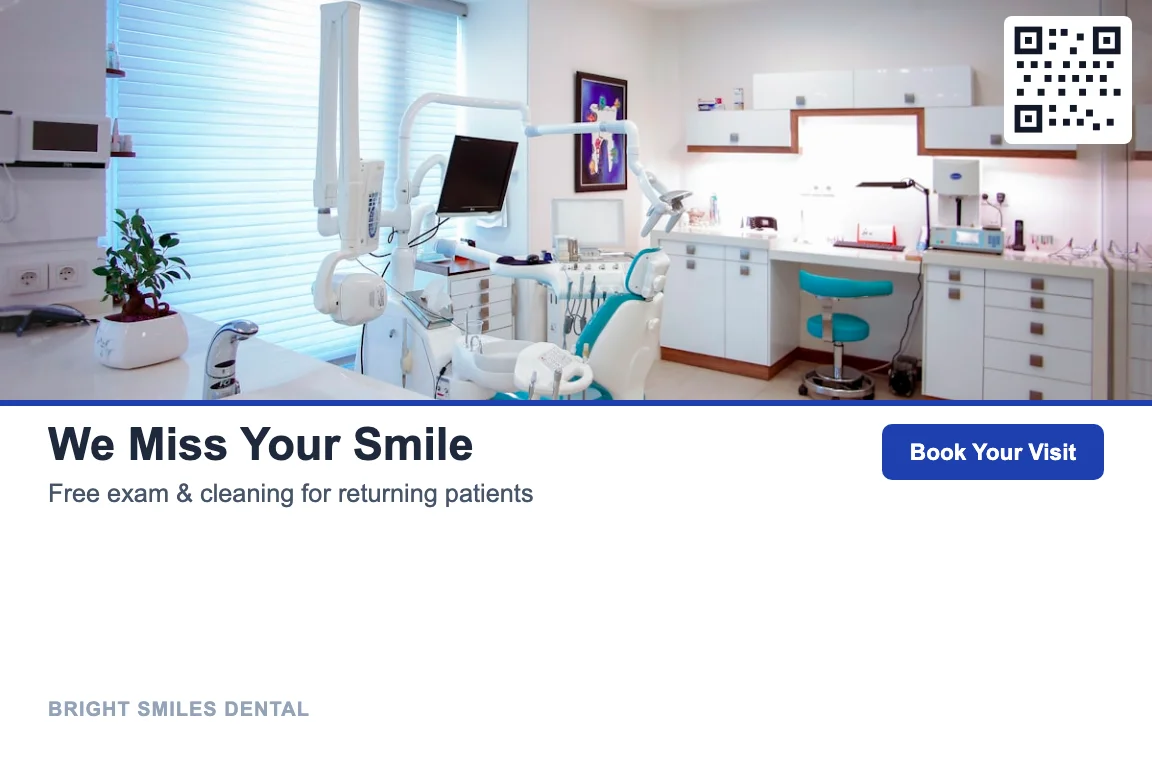
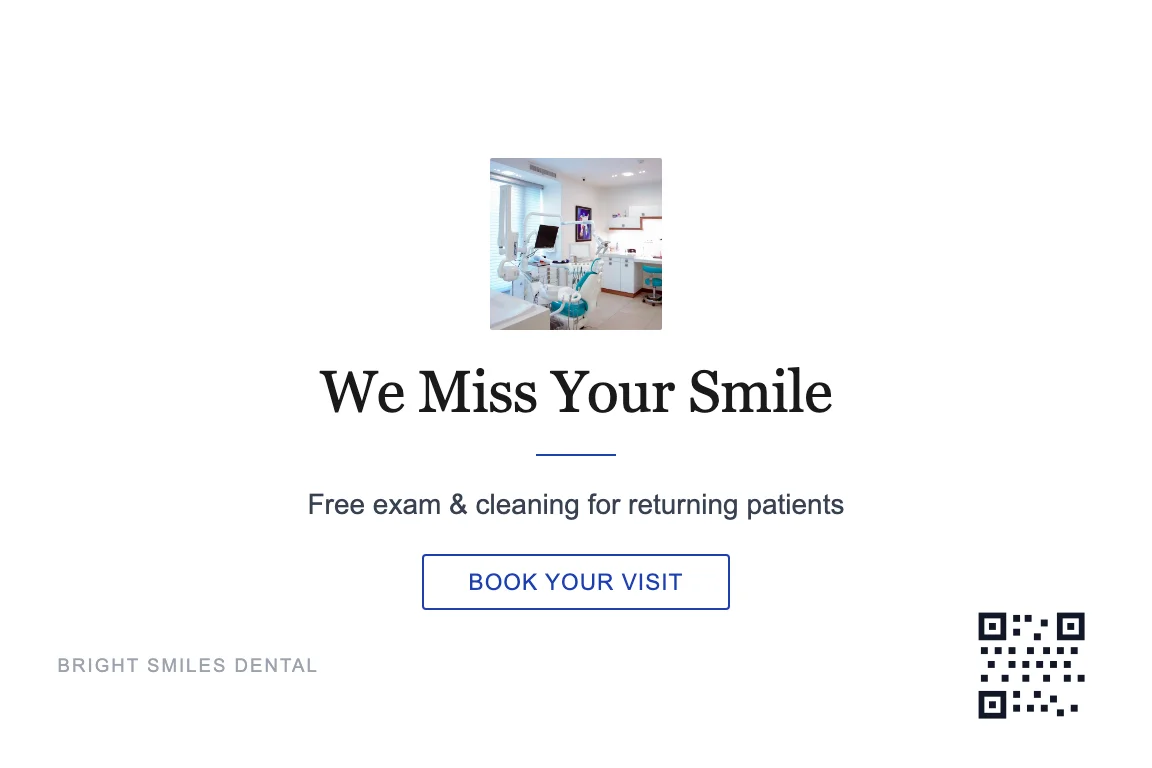
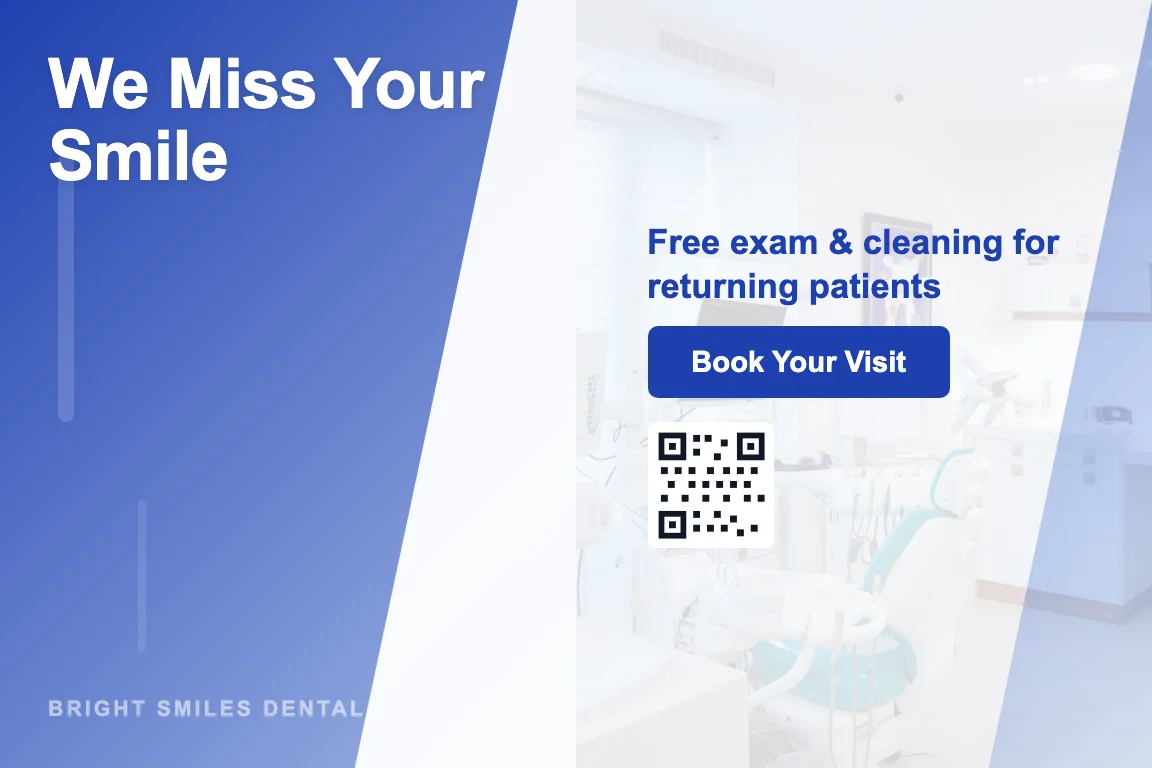
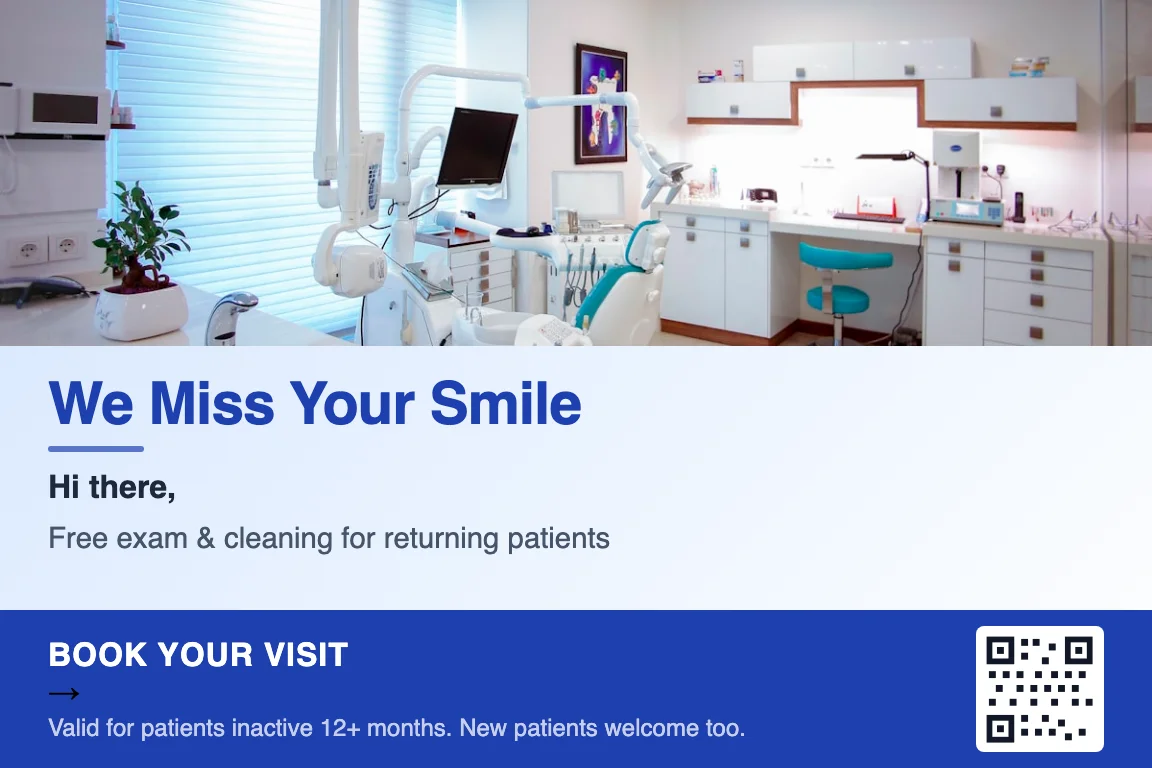
Design it in the in-app Design Studio in your practice's colors. Four starting styles — same offer and same call follow-up behind each, so pick the look that fits your brand.

Bold
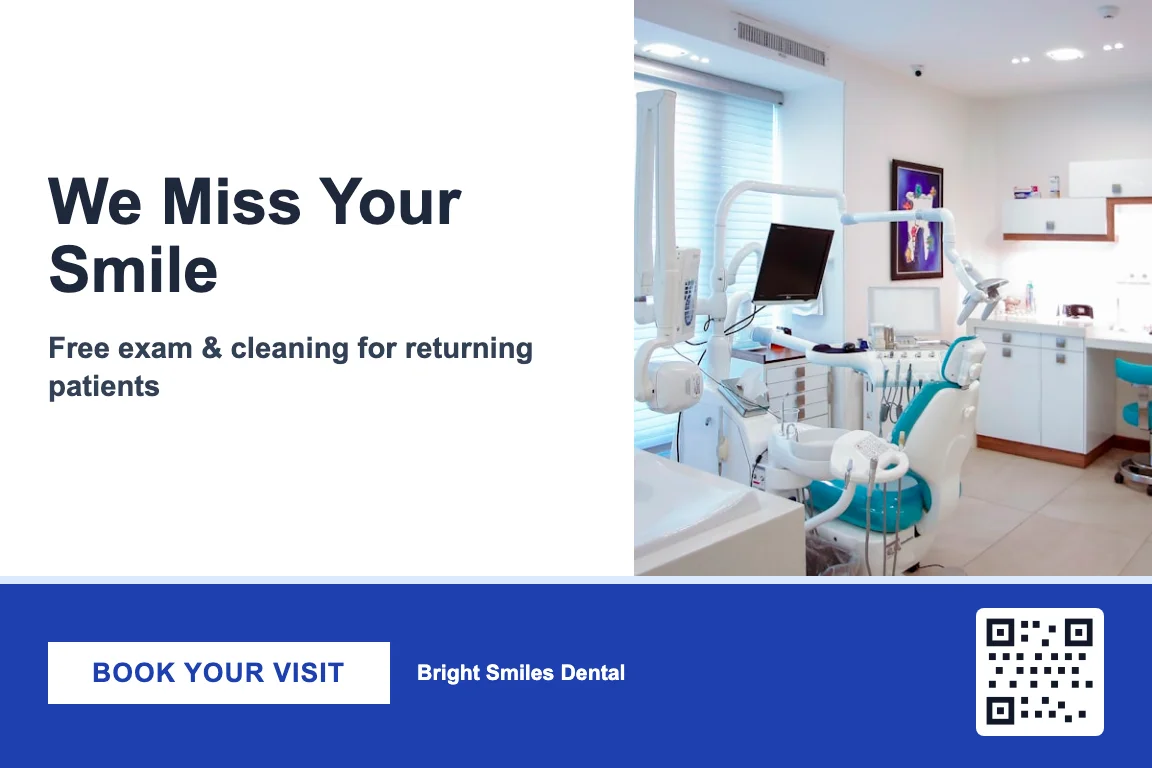
Bold dental reactivation postcard design front

Photo

Photo-led dental reactivation postcard design front

Minimal

Minimal dental reactivation postcard design front

Gradient

Gradient dental reactivation postcard design front

Front Detail

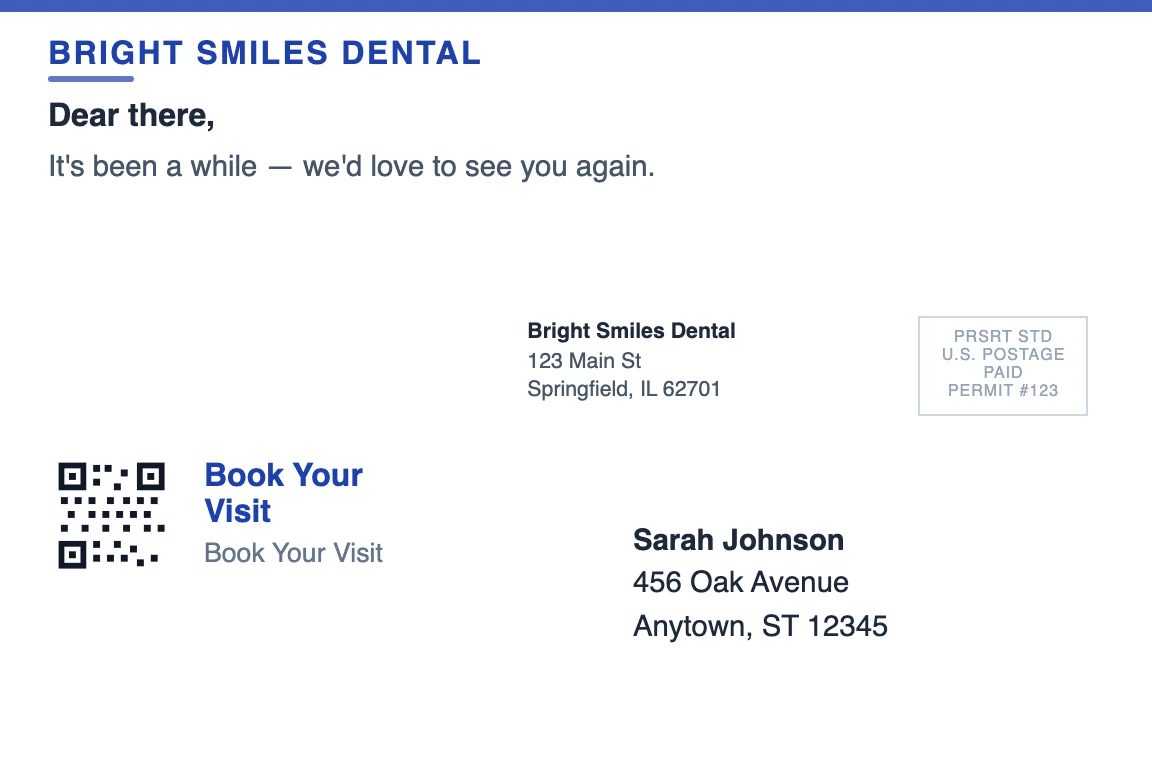
Detailed view of a dental reactivation postcard front

Back (Address Side)

Dental reactivation postcard back showing return address and recipient zone

Available in 4×6, 6×9, and 6×11. All-in pricing includes printing and USPS First-Class postage.

How PostKnock Runs It, End to End

1

Pull your lapsed list from your PMS

In Dentrix, Eaglesoft, Open Dental, Curve, Denticon — or any system — run a report for patients with no visit in 12+ months (or your own cutoff) and export it as a CSV. PostKnock doesn't connect to your PMS; you export the file, then import it.

2

Import the CSV — the wizard maps your columns

Drop in the export and the import wizard auto-maps name, address, phone, and last-visit columns. Segment overdue hygiene vs. long-lapsed vs. unscheduled treatment if you want different offers per group.

3

Pick the reactivation playbook & your card

Choose the wave sequence, set your dental offer, and design the postcard in the Design Studio. Add a QR code that points to your online scheduler so patients can self-book.

4

Launch — postcards mail, the queue fills

Cards print and ship via USPS First-Class automatically. A few days after delivery, every patient who hasn't rebooked drops into the Call Queue. Non-responders advance to the next wave on their own.

5

Front desk works the queue & you track scans

Staff calls down the queue with the pre-loaded script and logs each outcome. QR scans are tracked so you can see which cards drove online bookings versus calls.

A Worked Example (Your Numbers Will Vary)

Say a practice pulls 500 lapsed patients (no visit in 12+ months) and runs a 3-wave reactivation sequence with call follow-up. Here's the transparent math — the inputs are illustrative, not a guarantee:

  • 500 patients × 3 waves = 1,500 cards × $0.79/card (Pro 4×6) = ~$1,185 in postage + print
  • At an estimated 3–5% reactivation rate1 → roughly 15–25 patients rebooked
  • If a reactivated patient is worth, say, $1,000–$1,500/year in production to your practice…
  • …that's a meaningful return on the spend — plug in your own per-patient value to see yours.

Response and reactivation rates are industry-typical ranges, not PostKnock results. Per-patient value depends on your fee schedule and case mix. Add a Pro subscription ($99/mo) on top of per-piece cost if you want the Call Queue and multi-wave sequencing.

Simple, Transparent Pricing

Free to explore — you only pay when you're ready to send. Pay from your wallet per piece.

Free

$0/forever

Single-wave postcard campaigns · Design Studio · QR tracking · From $1.05/piece

Most Popular

Pro

$99/mo

Everything in Free + Call Queue & multi-wave sequencing · From $0.79/piece

Per-piece pricing includes printing + USPS First-Class postage. Pro is $99/mo or $799/yr. No setup fees, no minimums, no contracts.

🛡

Built for HIPAA-aware dental practices

PostKnock keeps PHI off the postcard by default. Marketing communications to your own patients are typically permitted under HIPAA without a BAA — we don't sign Business Associate Agreements and we don't ask you to upload PHI. Your reactivation export only needs name, address, and contact details. Read our healthcare compliance approach →

Frequently Asked Questions

What counts as a "lapsed" dental patient?

Most practices treat a patient as lapsed once they're overdue for recall — commonly 12+ months since their last cleaning or exam — or after a string of cancels and no-shows with no rebooked appointment. You set the cutoff when you pull the list from your practice management system; PostKnock just mails to whoever is on your CSV.

How is this different from my recall reminders?

Recall reminders are texts and emails the patient may have already tuned out. A reactivation postcard physically arrives in the mailbox with a specific offer, and on Pro the patient then drops into your Call Queue so the front desk follows up by phone. It's the postcard-plus-call one-two punch, not another notification.

Can I export patients from Dentrix, Eaglesoft, or Open Dental?

Yes. Dentrix, Eaglesoft, Open Dental, Curve, Denticon and most other systems let you run an inactive-patient report and export it as a CSV. Filter by last visit date to find patients overdue 12+ months, then import the CSV into PostKnock — the wizard auto-maps name, address, phone, and last-visit columns. PostKnock does not integrate directly with your PMS; you export the file and import it.

What offer should a dental reactivation postcard make?

One clear offer with a reason to act now works best: a complimentary exam with a scheduled cleaning, a hygiene discount, or a "use your benefits before year-end" nudge. Long-lapsed patients (2+ years) tend to respond better to a higher-value offer than a generic "we miss you." Always check your state dental board's advertising rules — you write the offer copy, PostKnock prints and mails it.

How many waves should a reactivation campaign have?

Most practices run 3 to 4 waves over several weeks, mixing postcards with one or two call attempts for non-responders. PostKnock supports multi-touch wave sequences of up to 5 waves; you control the timing and which waves are postcards versus calls. A single touch rarely rebooks — the follow-up is what closes it.

Do I need the phone calls, or can I just mail postcards?

You can mail postcards on the Free plan with no calls at all. The built-in Call Queue — which puts each lapsed patient in front of your front desk with a pre-loaded script after the card lands — is a Pro feature. For reactivation specifically, the call is usually what turns interest into a booked appointment, so most practices use it.

How do I reactivate patients who haven't visited in 2+ years?

Long-lapsed patients respond best to a specific, high-value offer — like a free comprehensive exam to re-establish their records — rather than a vague greeting. Pair it with a wave sequence and a follow-up call. Industry studies typically report direct-mail response in the low-single-digit-percent range on a house list, so expect a meaningful but modest share of a long-dormant list to come back.

What does it cost to reactivate my lapsed list?

You pay per piece from your wallet: from $1.05 per 4×6 card on the Free plan, dropping to $0.79 on Pro, with printing and USPS First-Class postage included. Pro is $99/mo (or $799/yr) and adds the Call Queue and multi-wave sequencing. No setup fees, no minimums, no contracts — you only pay for what you send.

Is this compliant for patient outreach?

PostKnock keeps PHI off the postcard by default and your export only needs name, address, and contact info. Marketing communications to your own patients are typically permitted under HIPAA without a BAA. We are HIPAA-aware: we don't sign Business Associate Agreements and we don't ask you to upload PHI. Review your own obligations and state dental advertising rules, and see our healthcare compliance approach for details.

Keep exploring

Turn Your Recall List Into Booked Chairs

Postcards that get attention. Callbacks that close the deal. Start free — you only pay when you send.

Start Free — No Credit Card

1 Response and reactivation figures are industry-typical ranges, not PostKnock results. House-list direct-mail response is commonly reported in the low-single-digit-to-high-single-digit percent range — e.g. ANA (Association of National Advertisers), Response Rate Report. Your results depend on your list, offer, and follow-up.

2 PostKnock supports three postcard sizes (4×6, 6×9, 6×11) and multi-touch wave sequences of up to 5 waves.