For Dental Offices

New Patient Acquisition
Postcards for Dental Offices

Every empty hygiene slot is a household within a few miles that doesn't know you exist yet. PostKnock mails new-patient postcards around your practice — then puts each scan and call-in on your front desk's radar so a real person can book the first visit.

Start Free — No Credit Card

Free plan from $1.05/card · Pro from $0.79/card · No contracts

2–5%
Estimated direct-mail response
range to a prospect list1
3
Postcard sizes — oversized
6×9 / 6×11 stand out in the box2
<30 min
Typical sign-up to
first campaign launched

Why New Patients Are Hard to Win — and Where Postcards Fit

A dental practice is a local, high-trust, recurring-revenue business. Your next new patient almost always lives within a short drive. The challenge isn't reach — it's getting in front of the right households at the right moment, before they search online and pick whoever ranks first. Here's where direct mail does what digital can't.

🚚

New movers need a dentist

Households that just moved into your area are actively choosing local providers — dentist, pharmacy, primary care. Reaching them in their first weeks, before they default to whoever shows up in a map search, is the single highest-intent window you get.

📍

Your draw area is tiny

Most patients won't drive far for a cleaning. A few ZIP codes or carrier routes around the office is your whole market — perfect for saturation mailing, where blanketing nearby streets costs far less per household than broad digital targeting.

📱

Search ads are a bidding war

"Dentist near me" clicks are some of the most expensive in local search, and you're bidding against every practice and DSO in town. A postcard lands in the mailbox with no auction — and there's no competitor's ad sitting next to it.

💰

A new patient is worth a lot

A first cleaning is just the start — recurring hygiene, restorative, the rest of the family. Because lifetime value is high, you can afford a real new-patient offer and still come out ahead, which is exactly what makes a strong mailed offer work.

🏫

Families decide together

One mailed offer to a household can win the parents and the kids at once. Back-to-school and start-of-year are natural moments for families to set up a new dental home — and a postcard reaches the whole address, not just one phone.

Interest fades without a callback

Plenty of people read a postcard, think "I should book that," and never do. The practices that win new patients pair the mailer with a phone follow-up — a real person who answers questions and gets the first visit on the calendar.

A Postcard Gets You Found. The Call Gets Them Booked.

A well-designed new-patient card with a clear offer earns the call-in or the QR scan. But cold prospects hesitate — "is this office taking my insurance?", "do they see kids?", "how far is it?" That's where a front-desk follow-up turns a maybe into a confirmed appointment. The postcard-plus-call one-two punch is what PostKnock is built for.

What stalls new-patient growth

  • × A pretty card with no offer and no reason to act now
  • × Mailing once and judging the whole channel on a single drop
  • × No tracking, so you can't tell which drop or design worked
  • × Inbound interest that nobody on the team follows up on

What books first appointments

  • ✓ A designed card with one strong new-patient offer + a deadline
  • ✓ A QR code that drops straight onto your online scheduler
  • ✓ Repeat drops to the same routes so households see you more than once
  • ✓ A front-desk follow-up call for prospects who reached out

Two Ways to Reach New Patients Near You

New-patient mail comes down to who's on the list. PostKnock supports both the targeted new-mover approach and broad saturation of the streets around your office — you bring the addresses, PostKnock prints, mails, and queues the follow-up.

New movers (targeted list)

Households that recently moved into your draw area are the highest-intent prospects you can mail — they need a dentist and haven't picked one yet. New-mover lists are widely available from list brokers; you export the addresses to a CSV and import them into PostKnock.

PostKnock mails to the list you import. Source your new-mover data from any list provider, then bring the CSV — PostKnock does not sell or generate the list for you.

Saturation (EDDM-style, by route)

Blanket the carrier routes and ZIP codes immediately around your office. Saturation mailing is the cheapest per-household way to build local awareness, and it's a strong fit for dental because your market is geographically tight — you only want the streets people will actually drive in from.

PostKnock supports EDDM-style saturation mailing. Per-piece pricing still includes printing and USPS postage.

Many practices run both: an always-on new-mover drip plus a periodic saturation push to nearby routes.

The Dental New-Patient Playbook

A multi-touch wave sequence built for cold prospects, not your existing patients. Postcards mail on schedule so the same households see you more than once; inbound interest flows into the Call Queue, and the sequence rolls forward automatically.

W1

Wave 1 — "Welcome to the neighborhood" intro postcard

Lead with the practice — who you are, where you are, that you're accepting new patients — and one clear new-patient offer. QR code to online scheduling. Oversized 6×9 or 6×11 helps a cold card get noticed in the stack.

W2

Wave 2 — Offer reminder, new angle

A few weeks later, a second card to the same households with a different design and a deadline on the offer. Repetition is how a cold prospect starts to recognize your name — one drop rarely converts a market.

W3

Wave 3 — Front-desk call for warm responders (Pro Call Queue)

When a prospect scans the QR or calls in but doesn't finish booking, your front desk works them from the Call Queue with a pre-loaded script: "Thanks for your interest — we have a couple of new-patient openings this week." Staff logs the outcome in one click.

W4

Wave 4 — Seasonal or family-focused card

Tie the next drop to a moment — back-to-school cleanings, start-of-year benefits, a families-welcome message. Then refresh the route or new-mover list and run the sequence again next cycle.

Wave count, timing, and call cadence are yours to set — PostKnock supports up to 5 waves. The phone-call waves use the built-in Call Queue, a Pro feature. Cold-prospect calls work best for inbound responders; honor your state's calling rules.

New-Patient Offers That Fit a Dental Practice

A cold prospect needs a concrete reason to choose you over the practice down the street. These are common, dental-appropriate new-patient angles you can drop into the postcard offer field — pick what fits your case mix and your state's dental advertising rules.

The classic new-patient special

  • • New-patient exam, cleaning & X-rays at a set price
  • • Complimentary first exam & consultation
  • • Whitening included with a new-patient visit

For new movers

  • • "Welcome to the neighborhood" first-visit offer
  • • "We're your closest dentist" with a simple map
  • • Easy first-appointment scheduling, same week

For families & kids

  • • Back-to-school cleaning push for kids
  • • Book the whole family in one visit
  • • Kid-friendly / new-family-welcome messaging

For the uninsured or fee-conscious

  • • In-house membership / savings plan intro
  • • "We accept most PPO plans" reassurance
  • • Transparent first-visit pricing, no surprises

Offers are illustrative. You set the offer copy; PostKnock prints and mails the card and queues the follow-up call. Some states restrict "free" dental offers — check your dental board's rules.

What Your New-Patient Card Looks Like

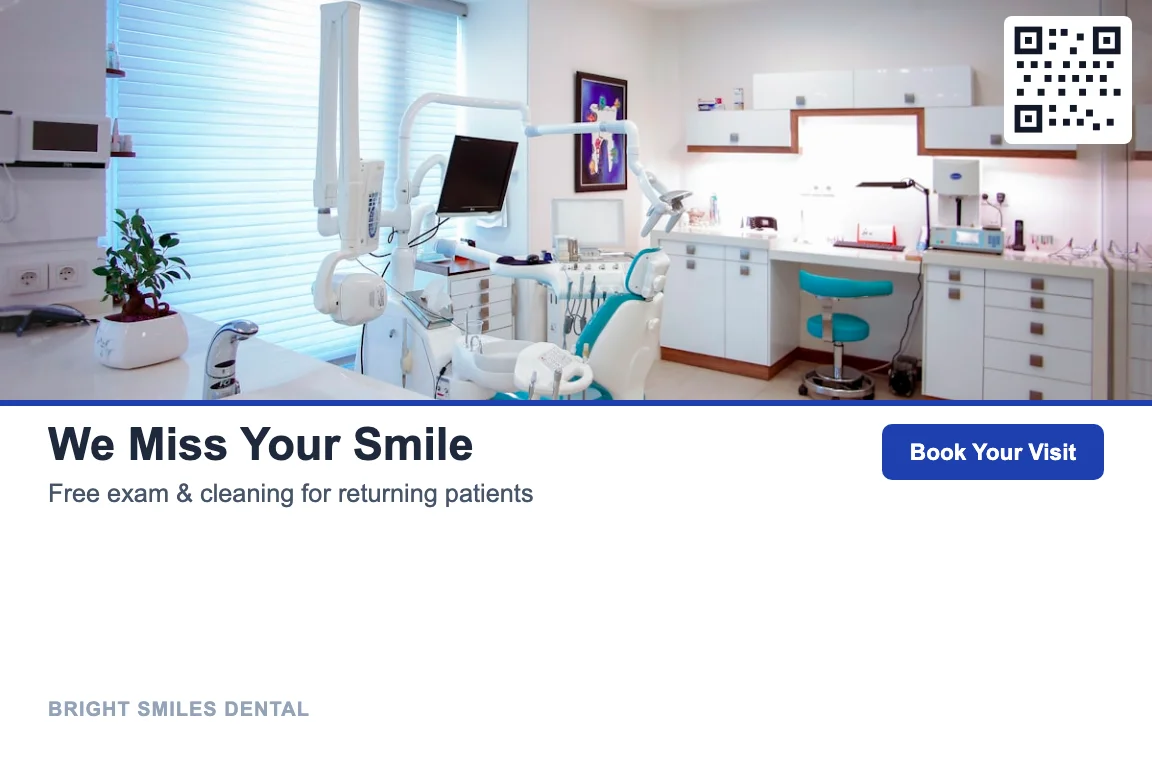
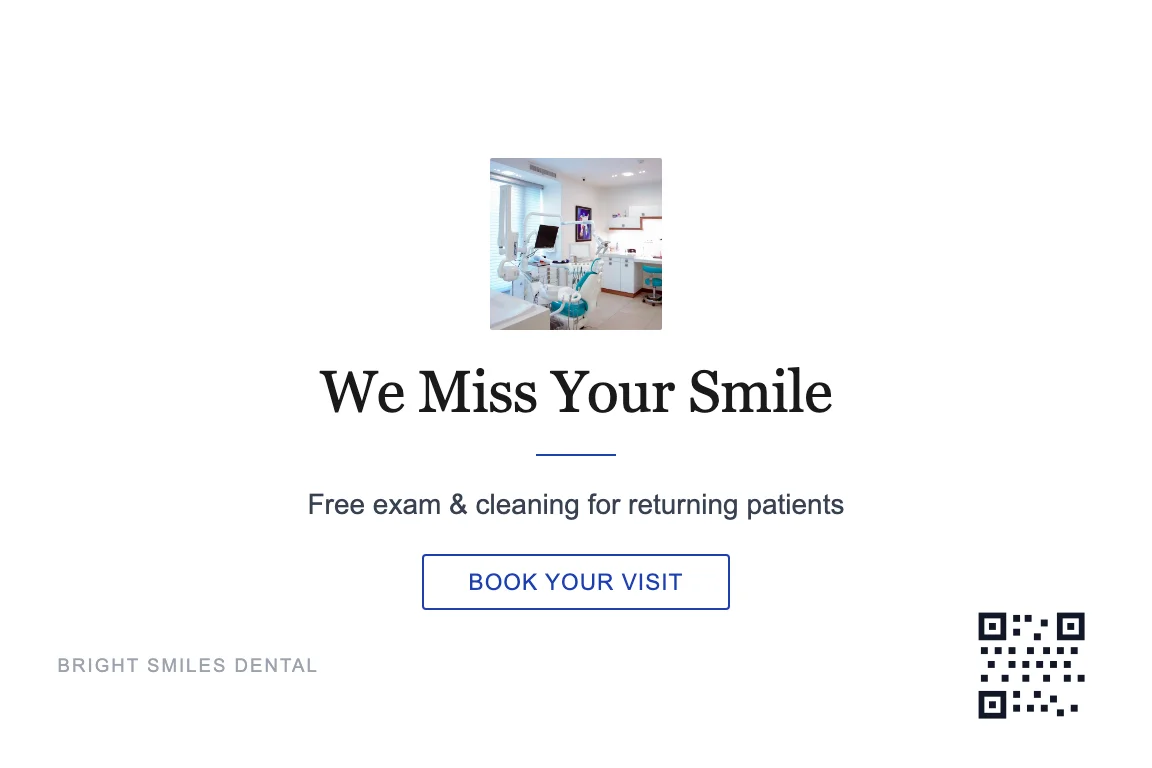
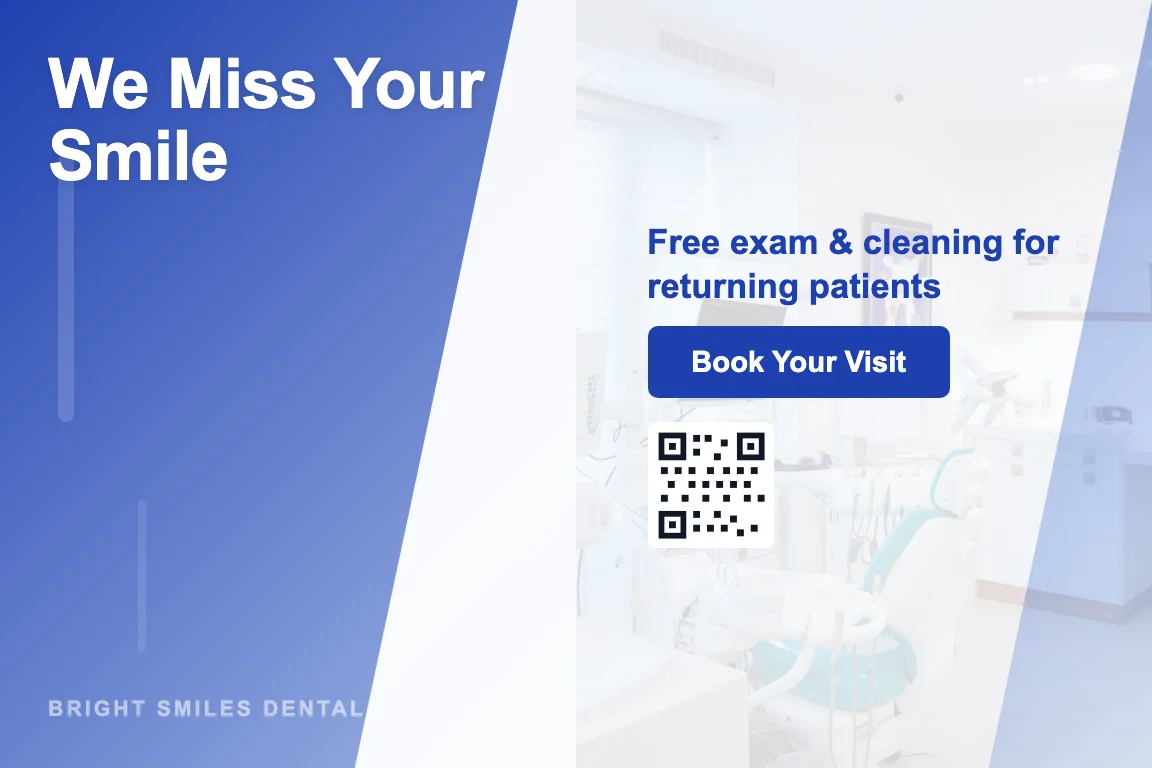
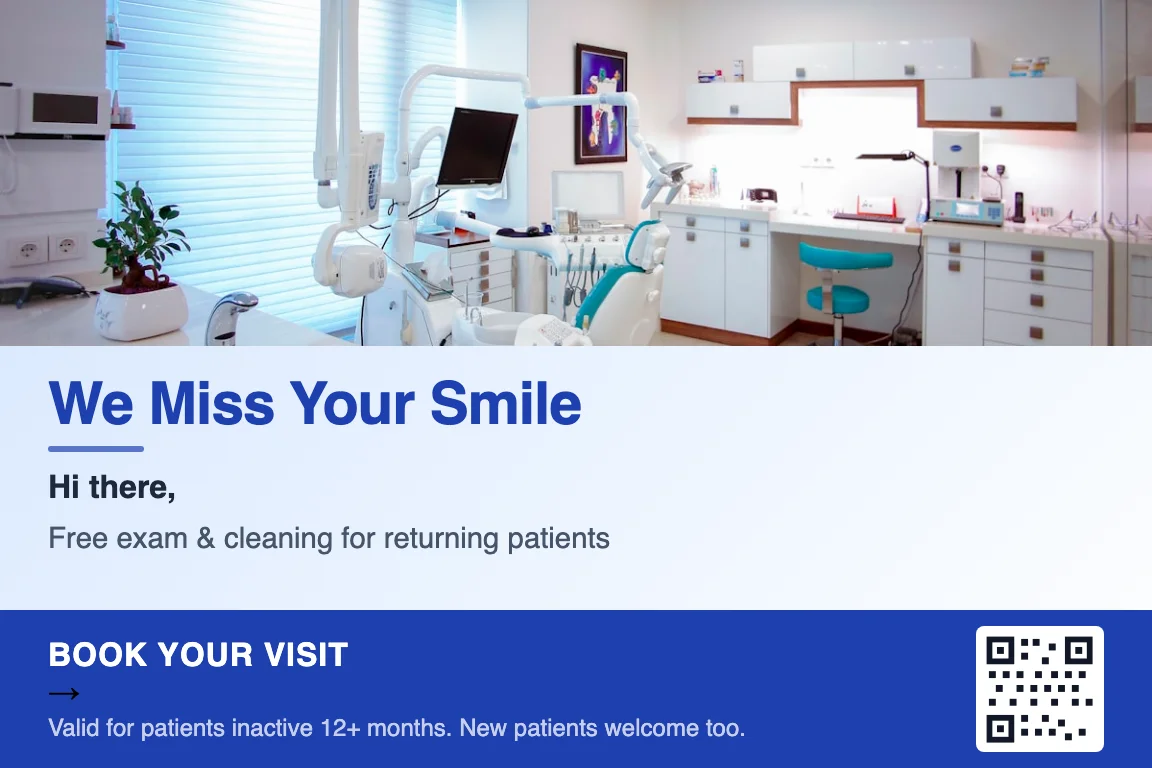
Design it in the in-app Design Studio in your practice's colors. Four starting styles — same offer and same call follow-up behind each, so pick the look that fits your brand and your neighborhood.

Bold
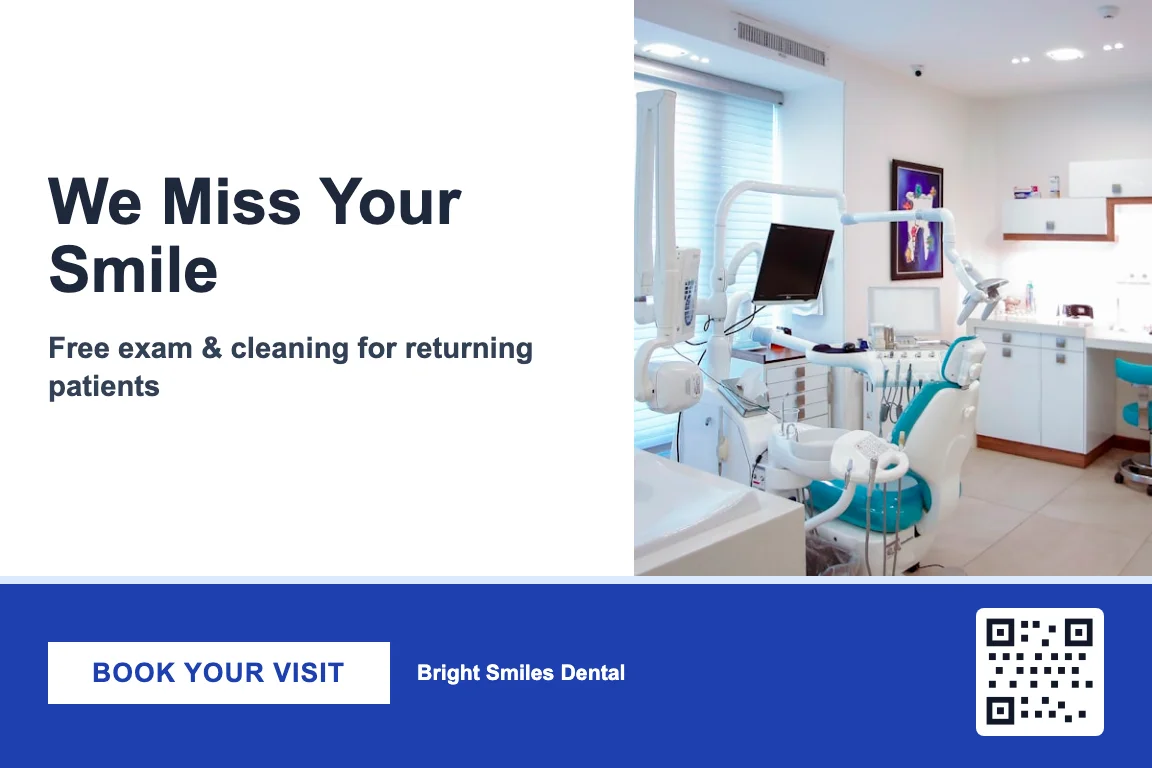
Bold dental new patient postcard design front

Photo

Photo-led dental new patient postcard design front

Minimal

Minimal dental new patient postcard design front

Gradient

Gradient dental new patient postcard design front

Front Detail

Detailed view of a dental new patient postcard front

Back (Address Side)

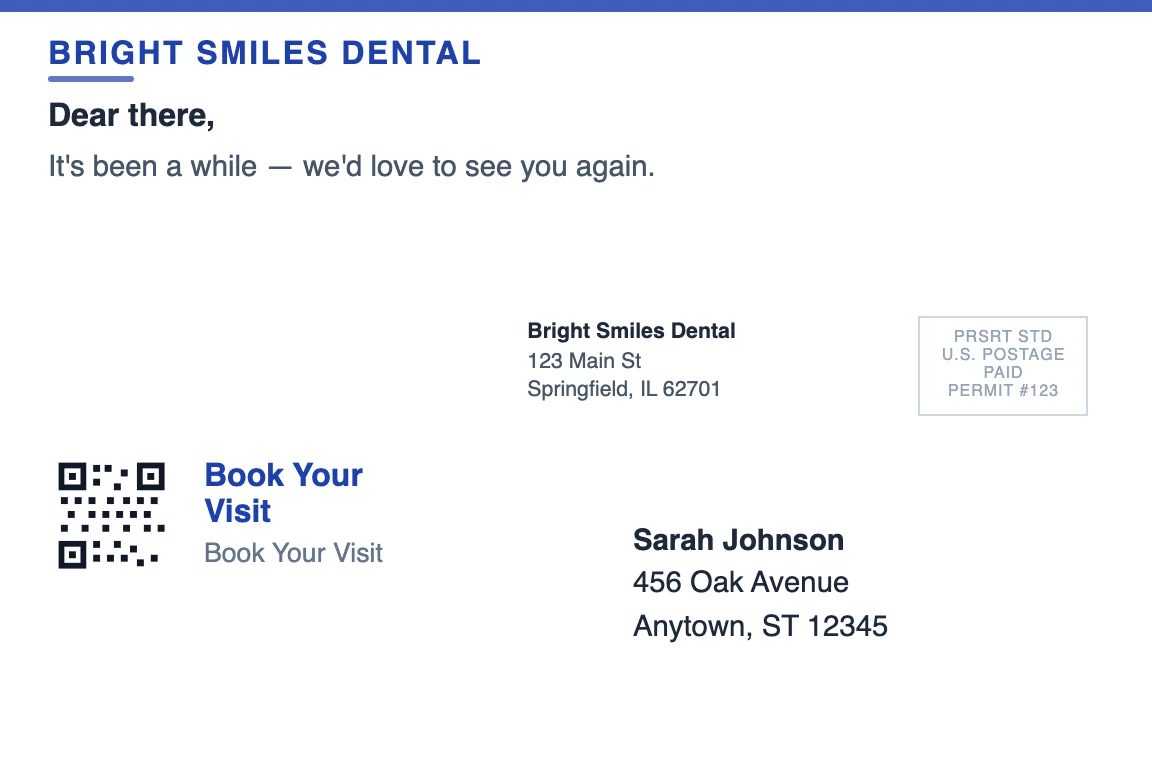
Dental new patient postcard back showing return address and recipient zone

Available in 4×6, 6×9, and 6×11. For cold new-patient prospects, the oversized 6×9 and 6×11 sizes stand out in a crowded mailbox. All-in pricing includes printing and USPS First-Class postage.

How PostKnock Runs It, End to End

1

Get your prospect list as a CSV

For new movers, order a new-mover list for your ZIP codes from any list broker and export it to CSV. For saturation, pull the carrier routes around your office. PostKnock mails to the list you bring — it doesn't sell or generate the list, and it doesn't connect to outside systems; you bring the file and import it.

2

Import the CSV — the wizard maps your columns

Drop in the file and the import wizard auto-maps name, address, and phone columns. Keep new movers and saturation routes as separate segments if you want a different offer or design for each.

3

Pick the new-patient playbook & design your card

Choose the wave sequence, set your new-patient offer, and design the postcard in the Design Studio — pick a size (oversized cards stand out for cold prospects). Add a QR code that points to your online scheduler so prospects can self-book.

4

Launch — postcards mail, interest gets tracked

Cards print and ship via USPS First-Class automatically. QR scans are tracked so you can see which design and which route or list drove the most interest. Non-responding households advance to the next wave on their own.

5

Front desk works the queue & books first visits

On Pro, prospects who showed interest drop into the Call Queue with a pre-loaded script. Your front desk calls down the list, answers the insurance and location questions, and gets the first appointment on the calendar — logging each outcome in one click.

A Worked Example (Your Numbers Will Vary)

Say a practice mails 2,000 nearby households a 2-wave new-patient sequence. Here's the transparent math — the inputs are illustrative, not a guarantee:

  • 2,000 households × 2 waves = 4,000 cards × $0.79/card (Pro 4×6) = ~$3,160 in postage + print
  • At an estimated 0.5–2% response rate1 on a cold prospect list → roughly 10–40 inquiries, of which some convert to booked new patients
  • If a new patient is worth, say, $600–$1,200 in first-year production (and more over their lifetime as a hygiene patient)…
  • …even a modest handful of booked new patients can cover the spend — plug in your own per-patient value and conversion to see yours.

Response and conversion rates are industry-typical ranges, not PostKnock results. Cold prospect lists generally respond lower than your own house list. Per-patient value depends on your fee schedule and case mix. Add a Pro subscription ($99/mo) on top of per-piece cost if you want the Call Queue and multi-wave sequencing.

Simple, Transparent Pricing

Free to explore — you only pay when you're ready to send. Pay from your wallet per piece.

Free

$0/forever

Single-wave postcard campaigns · Design Studio · QR tracking · From $1.05/piece

Most Popular

Pro

$99/mo

Everything in Free + Call Queue & multi-wave sequencing · From $0.79/piece

Per-piece pricing includes printing + USPS First-Class postage. Pro is $99/mo or $799/yr. No setup fees, no minimums, no contracts.

🛡

Built for HIPAA-aware dental practices

New-patient mailing is the easy case for compliance: you're mailing to prospects and new movers, not patients, so there's no PHI involved. PostKnock keeps PHI off the postcard by default — we don't sign Business Associate Agreements and we don't ask you to upload PHI. Read our healthcare compliance approach →

Frequently Asked Questions

How do I get a list of new movers near my dental office?

New-mover lists for specific ZIP codes are widely available from list brokers and data providers. You order the addresses for your draw area, export them to a CSV, and import the file into PostKnock. PostKnock mails to whatever list you bring — it doesn't sell or generate the list for you, and it doesn't connect to outside systems, so you handle the data sourcing and bring the CSV.

Should I target new movers or saturate nearby routes?

Both work and many practices do both. New-mover targeting reaches the highest-intent households — people who need a dentist and haven't chosen one. Saturation (EDDM-style) blankets the carrier routes around your office at the lowest cost per household and builds broad local awareness. For a tight dental draw area, an always-on new-mover drip plus periodic saturation is a common combination.

What's a good new-patient offer to put on the postcard?

One clear offer with a reason to act works best: a set-price new-patient exam, cleaning and X-rays; a complimentary first consultation; or a "welcome to the neighborhood" offer for new movers. Because a new patient's lifetime value is high, you can afford a strong offer. Check your state dental board's advertising rules — some restrict "free" language — and remember you write the offer copy; PostKnock prints and mails it.

How is new-patient mail different from reactivation mail?

Reactivation mails to people who are already your patients but have lapsed — it's a warm list, so response is usually higher. New-patient acquisition mails to cold prospects (new movers or nearby households) who don't know you yet, so response is typically lower and repetition matters more. The mechanics in PostKnock are the same; the list, the offer, and the expected response rate differ. If you want to win back lapsed patients instead, see our dental reactivation page.

How many times should I mail the same households?

Cold prospects rarely act on a single drop — recognition builds with repetition. Most practices run 2 to 4 waves to the same routes or new-mover list over several weeks. PostKnock supports multi-touch wave sequences of up to 5 waves; you control the timing and whether each wave is a postcard or a call. For acquisition specifically, mailing once and judging the channel on that one drop is the most common mistake.

Can I just mail postcards, or do I need the phone calls?

You can mail postcards on the Free plan with no calls at all. The built-in Call Queue — a Pro feature — puts prospects who showed interest in front of your front desk with a pre-loaded script. For new patients, calls are most useful for following up on inbound responders (people who scanned the QR or called in but didn't finish booking) rather than cold-dialing strangers; honor your state's calling rules.

What response rate should I expect from new-patient mail?

Industry studies typically report direct-mail response to cold prospect lists in the low-single-digit-percent range — often well under your response from a house list of existing patients. A new-mover list tends to respond better than broad saturation because intent is higher. Expect a modest response percentage, and remember that because a new patient's value is high, even a small number of bookings can pay for the mailing. These are industry ranges, not PostKnock guarantees.

What does a new-patient campaign cost?

You pay per piece from your wallet: from $1.05 per 4×6 card on the Free plan, dropping to $0.79 on Pro, with printing and USPS First-Class postage included. Oversized 6×9 and 6×11 cost a bit more per piece but stand out for cold prospects. Pro is $99/mo (or $799/yr) and adds the Call Queue and multi-wave sequencing. No setup fees, no minimums, no contracts — you only pay for what you send. List costs from your data provider are separate.

Is mailing to prospects compliant for a dental office?

New-patient acquisition mail goes to prospects and new movers, not your patients, so there's no PHI involved — it's the simplest case for compliance. PostKnock keeps PHI off the postcard by default; we are HIPAA-aware but don't sign Business Associate Agreements and don't ask you to upload PHI. Always review your state dental board's advertising rules and any list-source terms for the prospect data you use.

Keep exploring

Fill Your Schedule With New Patients

Postcards that get attention. Callbacks that close the deal. Start free — you only pay when you send.

Start Free — No Credit Card

1 Response and conversion figures are industry-typical ranges, not PostKnock results. Direct-mail response to prospect (non-house) lists is commonly reported in the low-single-digit percent range, and below house-list response — e.g. ANA (Association of National Advertisers), Response Rate Report. Your results depend on your list source, offer, mailing area, and follow-up.

2 PostKnock supports three postcard sizes (4×6, 6×9, 6×11) and multi-touch wave sequences of up to 5 waves. Oversized formats can help a cold-prospect mailer stand out but cost more per piece.